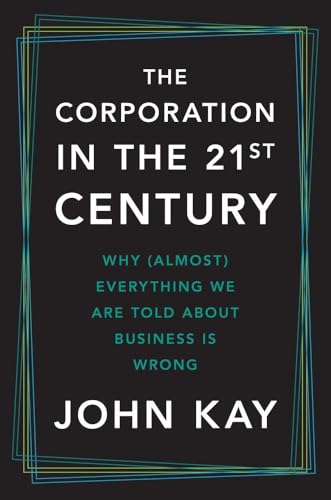
The Corporation In the 21st Century : Why (Almost) Everything We Are Told About Business Is Wrong / John Kay.
Material type: TextPublisher: New Haven ; London : Yale University Press, 2024Copyright date: ©2024Description: 6 unnumbered, 442 pages : illustrations ; 24 cmContent type:
 - text
- unmediated
- volume
- 9780300280197
- 9780300285505
- Corporation In the Twenty-First Century : Why (Almost) Everything We Are Told About Business Is Wrong
- Why (Almost) Everything We Are Told About Business Is Wrong
- 23 338.740973
- HD2731 .K38 2024
| Item type | Current library | Call number | Materials specified | Status | Date due | Barcode | |
|---|---|---|---|---|---|---|---|
 Books
Books
|
MYCC Library General stacks | 338.740973 KAY 2024 (Browse shelf(Opens below)) | Available | 11131 | |||
 Reference
|
MYCC Library Reference | 338.740973 KAY 2024 REF (Browse shelf(Opens below)) | Not for loan | 11130 |
Includes bibliographical references (pages 396-428) and index.
Introduction: business in society -- Part I: The background -- 1. Love the product, hate the producer -- 2. A history of pharmaceuticals: a case for treatment -- 3. Economic motivation-- Part 2: A brief history of business -- 4. The mechanical firm -- 5. The rise of manufacturing -- 6. The rise of corporations -- 7. Changing fortunes -- 8. The decline of manufacturing -- Part 3: The secret of our success -- 9. Better at everything -- 10. Better at business -- 11. Value -- 12. Stanley Matthews changes trains -- Part 4: The age of individualism -- 13. Money can't buy you love -- 14. Or perhaps it can: the modern theory of the firm -- 15. The myth of ownership -- 16. Must companies maximise profits? -- 17. Leaky pipes and overflowing sewage -- 18. The dumbest idea in the world -- Part 5: How it all worked out -- 19. The evolution of finance -- 20. The art of the deal -- 21. Not a pretty picture -- 22. The fall of the icons -- 23. The finance curse -- Part 6: The corporations in the twenty-first century -- 24. Combinations and capabilities -- 25. A letter from Arnold Weinstock -- 26. The MacNeil returns to Barra -- 27. The hollow corporation -- Part 7: Capital in the twenty-first century -- 28. Capital as a service -- 29. Capital and wealth -- 30. Who are the capitalists now? -- 31. In search of capital -- Part 8: The best of times, the worst of times -- 32. Ambiguity is a feature, not a bug -- 22. After capitalism.
"In the world of Adam Smith and Karl Marx, capitalists built and controlled mills and factories. That relationship between capital and labor continued in the automobile assembly lines and petrochemical plants of the twentieth century. But no longer: products and production have dematerialized. The goods and services provided by the leading companies of the twenty-first century appear on your screen, fit in your pocket, or occupy your head. Ownership of the means of production is a redundant concept. Workers are the means of production; increasingly, they take the plant home. Capital is a service bought from a specialist supplier with little influence over customer businesses. The professional managers who run modern corporations do not exert authority because they are wealthy; they are wealthy because they exert authority. John Kay's incisive overhaul of our ideas about business redefines our understanding of successful commercial activity and the corporation--and describes how we have come to "love the product" as we "hate the producer." This is a brilliant and original work from one of the greatest economists." --Publisher's description.
There are no comments on this title.