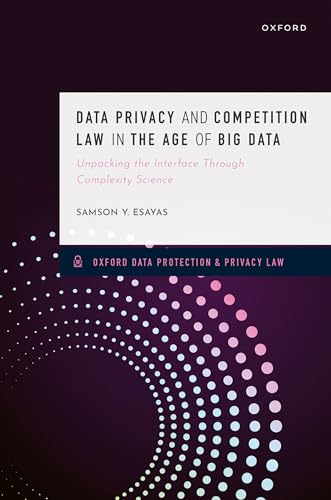
Data Privacy and Competition Law in the Age of Big Data : Unpacking the Interface Through Complexity Science / Samson Y. Esayas.
Material type: TextSeries: Oxford data protection & privacy law | Oxford data protection & privacy lawPublisher: New York : Oxford University Press, 2024Copyright date: ©2024Description: xxiv, 350 pages ; 24 cmContent type:
 - text
- unmediated
- volume
- 9780198891420
- 23 342.0858 DOI: 10.1093/oso/9780198891420.001.0001
| Item type | Current library | Call number | Materials specified | Status | Date due | Barcode | |
|---|---|---|---|---|---|---|---|
 Books
Books
|
MYCC Library General stacks | 342.0858 ESA 2024 (Browse shelf(Opens below)) | Available |
Browsing MYCC Library shelves, Shelving location: General stacks Close shelf browser (Hides shelf browser)


Includes index.
Data privacy and competition law in the age of big data -- The idea of emergent properties in data privacy law -- Digital ecosystems, emergent harms, and the need for a holistic approach in competition law -- The interface between data privacy and competition law : insights from complexity science -- Merger control and theories of harm on data privacy as a non-price parameter -- Privacy fixing and other forms of anticompetitive cooperation on privacy -- Excessive data collection and unfair privacy policies as forms of abuse of dominance -- Regulating a complex economy : beyond the atomistic and either/or approaches.
The commercialization of personal data challenges both data privacy law and competition law in the era of big data. It explains that modern data practices such as extensive data aggregation, multi-purpose processing, and ecosystem-based business models create complex, interconnected economic systems with emergent risks. However, current legal approaches tend to analyze issues in isolation, overlooking system-wide harms and the growing overlap between the two legal regimes. The book argues for a recalibration of data privacy and competition law through a holistic, systems-level and polycentric approach that better addresses emergent risks and promotes synergy between the two frameworks.
There are no comments on this title.