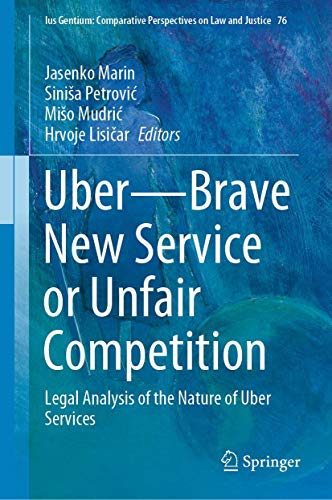
Uber-Brave New Service or Unfair Competition: Legal Analysis of the Nature of Uber Services / edited by Jasenko Marin, Siniša Petrović and Mišo Mudrić
Material type: TextSeries: | Ius Gentium: Comparative Perspectives On Law And Justice, Volume 76Publisher: Cham, Switzerland: Springer International Publishing : 2020Copyright date: ©2020Description: x, 213pages ; 24 cmContent type:
 - text
- unmediated
- volume
- 9783030315344
- 9783030315351
- 23 346
| Item type | Current library | Call number | Materials specified | Status | Date due | Barcode | |
|---|---|---|---|---|---|---|---|
 Books
Books
|
MYCC Library General stacks | 346 UBE 2020 (Browse shelf(Opens below)) | Available | 10648 |
Browsing MYCC Library shelves, Shelving location: General stacks Close shelf browser (Hides shelf browser)


Includes bibliographical references.
Chapter 1. Introduction -- Chapter 2. Comparative Analysis of Public Carriage of Passengers by Road Services: Taxi Services and Rent-a-Car with Driver Services -- Chapter 3. Digital Economy and Ride-Sharing in Perspective -- Chapter 4. Internet Platforms and Carriage of Passengers by Road Sector -- Chapter 5. Freedom of Services and Carriage of Passengers by Road Sector -- Chapter 6. C-434/15 -- Nature of Uber Services and Carriage of Passengers by Road Sector -- Chapter 7. Laissez-faire and Status Quo Models for Uber Services Regulation -- Chapter 8. Legal Adjustment and New Legislative Paradigm Models for Uber Services Regulation -- Chapter 9. Passengers Rights and Consumer Protection -- Chapter 10. Data Protection and Consumer Protection -- Chapter 11. Market Competition in the Carriage of Passengers Market -- Chapter 12. Uber Incorporated: Breaking the Legal Veil -- Chapter 13. Employees vs. Self-Employed Status Ramifications -- Chapter 14. Taxation Law and Contracting of Uber Services -- Chapter 15. Summary and Main Findings.
This book analyzes the legal issues connected with the provision of Uber-related services. It primarily focuses on the various contractual and non-contractual relationships that occur during the use of Uber applications, especially with reference to Uber headquarters (Uber App), Uber branch offices (advertisements), Uber partner drivers (employees or self-employed), Uber application registered users, Uber transportation service users (contracting passenger) and third-party Uber transportation service users (additional passenger). It also provides a comparison of standard transportation services and contracts of carriage, irrespective of whether the carrier in question is a common carrier, contractual carrier, actual carrier or an intermediary service provider. Furthermore, the book presents the relevant case law, especially with regard to Uber as a taxi service, Uber as a share-riding service, Uber as a rent-a-car with driver service, Uber as an employer and Uber as a key organizer of transportation service, in Croatia, Belgium, Germany, Italy, the Netherlands, United Kingdom, United States, Hungary, Argentina, and France. Lastly, it explores the different legislative approaches to resolving various issues related to the appearance of Uber and similar companies - the Laissez-faire model, Status Quo model, Legal Adjustment model, and the New Legislative Paradigm model.
There are no comments on this title.