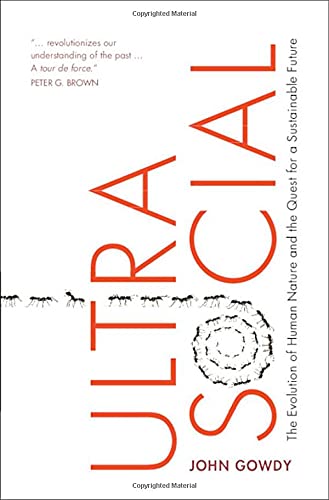
ULTRASOCIAL : The Evolution of Human Nature and the Quest for a Sustainable Future / John M. Gowdy.
Material type: TextPublisher: Cambridge ; New York, NY : Cambridge University Press, 2021Copyright date: ©2021Description: xiv, 269 pages: 24 cmContent type:
 - text
- unmediated
- volume
- 9781108838269
- 9781108978644
- 304.2 23
| Item type | Current library | Call number | Materials specified | Status | Date due | Barcode | |
|---|---|---|---|---|---|---|---|
 Books
Books
|
MYCC Library General stacks | 304.2 GOW 2021 (Browse shelf(Opens below)) | Available | 10073 | |||
 Reference
|
MYCC Library Reference | 304.2 GOW 2021 REF (Browse shelf(Opens below)) | Not for loan | 10074 |
Browsing MYCC Library shelves, Shelving location: General stacks Close shelf browser (Hides shelf browser)

|

|

|

|

|

|

|
||
| 303.4833 MCA 2017 Machine, platform, crowd: harnessing our digital future | 303.48330973 DIG 2018 Digital dominance : the power of Google, Amazon, Facebook, and Apple / | 303.49595 BEY 2011 Beyond expectations | 304.2 GOW 2021 ULTRASOCIAL : The Evolution of Human Nature and the Quest for a Sustainable Future / | 305.42 WOM 2020 VOL. 1 Women & Antitrust : Voices from the Field / Vol. 1 | 305.42 WOM 2020 VOL. 2 Women & Antitrust : Voices from the Field / Vol. 2 | 306.3 SCH 2013 Leading from the emerging future : from ego-system to eco-system economies / |
Includes bibliographical references and index.
The ultrasocial origin of our existential crisis -- The evolution of ultrasociality in humans and social insects -- Our hunter-gatherer heritage and the evolution of human nature -- The agricultural transition and how it changed our species -- The rise of state societies -- The modern state/market superorganism -- Neoliberalism : the ideology of the superorganism -- Taming the market : a minimal bioeconomic program -- Evolving a sustainable and equitable future : what can we learn from nonmarket cultures? -- Reclaiming human nature : the future will be better (eventually).
"Ultrasocial argues that rather than environmental destruction and extreme inequality being due to human nature, they are the result of the adoption of agriculture by our ancestors. Human economy has become an ultrasocial superorganism (similar to an ant or termite colony), with the requirements of the superorganism taking precedence over the individuals within it. Human society is now an autonomous, highly integrated network of technologies, institutions, and belief systems dedicated to the expansion of economic production. Recognizing this allows a radically new interpretation of free market and neoliberal ideology that - far from advocating personal freedom - leads to sacrificing the well-being of individuals for the benefit of the global market. Ultrasocial is a fascinating exploration of what this means for the future direction of humanity: Can we forge a better, more egalitarian, and sustainable future by changing this socioeconomic - and ultimately destructive - path? John Gowdy explores how this might be achieved"-- Provided by publisher.
There are no comments on this title.